Home / Articles
SMILE LASIK Recovery: Complete Guide for US Patients
Home / Articles
SMILE LASIK Recovery: Complete Guide for US Patients
Most online recovery guides are written for patients who never leave their home city, leaving American medical tourists without precise answers to the questions that matter most: how many days must you stay in Seoul before it is safe to fly, what do your eyes actually feel like on day two versus day five, and how do you manage post-operative care once you are back stateside with no access to your Korean surgeon? The information gap is not just inconvenient — it creates unnecessary anxiety and, in some cases, leads patients to make decisions that compromise their outcomes.
Before you finalize your Seoul itinerary, it is worth making sure you understand what SMILE LASIK is and how it works, as well as whether you are a good candidate for the procedure — both of which will deepen the context for everything covered in this recovery guide.
By the end of this guide, you will understand the precise SMILE LASIK recovery timeline from the first hour post-surgery through month three and beyond, the day-by-day experience during your Seoul recovery stay including what to expect from your vision and comfort level, exactly when you can safely fly home to the USA and what to do on the plane, how to manage your recovery and follow-up care once you are back in America, and activity-specific return timelines for work, exercise, makeup, swimming, golf, and professional events.
Understanding the clinical foundation of your recovery is what separates a prepared patient from an anxious one. Before diving into the hour-by-hour detail of your Seoul stay, this section gives you the essential framework: why SMILE LASIK recovery is physiologically faster than traditional LASIK, what you will actually feel in the first hours after surgery, and the honest, research-backed timeline for each recovery milestone. For a deeper look at the clinical safety data for SMILE LASIK, including peer-reviewed outcome evidence, that companion article covers the evidence base in full. Similarly, understanding SMILE LASIK's dry eye profile compared to LASIK will give you important context for the dry eye discussion throughout this guide.
Many patients describe a mild foreign-body sensation in the first 24 hours — similar to the feeling of a small grain of sand in the eye — which corresponds to the small incision site in the early stages of healing. Tearing and mild redness are also normal for the first 24 to 48 hours and require no intervention. Your vision immediately post-op will range from blurry to hazy — this is entirely temporary and resolves progressively over the first 24 to 72 hours as the cornea begins its healing response.
Functional recovery — vision usable for daily tasks including navigation, basic reading, and orientation — occurs within 24 to 48 hours for most patients. Work-ready recovery for screen-based office roles typically follows within three to five days. The prescription begins settling almost immediately but continues fine-tuning for four to twelve weeks, depending on the patient's pre-operative prescription and individual healing response. Complete corneal healing at the cellular level takes up to three months — which is why the Month 3 virtual follow-up appointment matters even when vision feels stable and clear well before that point.
Recovery Milestone | Typical Timeframe | Notes |
|---|---|---|
Functional vision | 24–48 hours | Blurry-to-clear progression |
Light sensitivity resolution | 2–5 days | Sunglasses recommended outdoors |
Redness resolution | 3–7 days | Varies by individual |
Return to office work | 3–5 days | Screen use with regular breaks |
Safe to fly internationally | Day 3 minimum | Clinic clearance required |
Vision stabilization | 4–12 weeks | Final prescription settled |
Complete corneal healing | Up to 3 months | SCI data-supported |
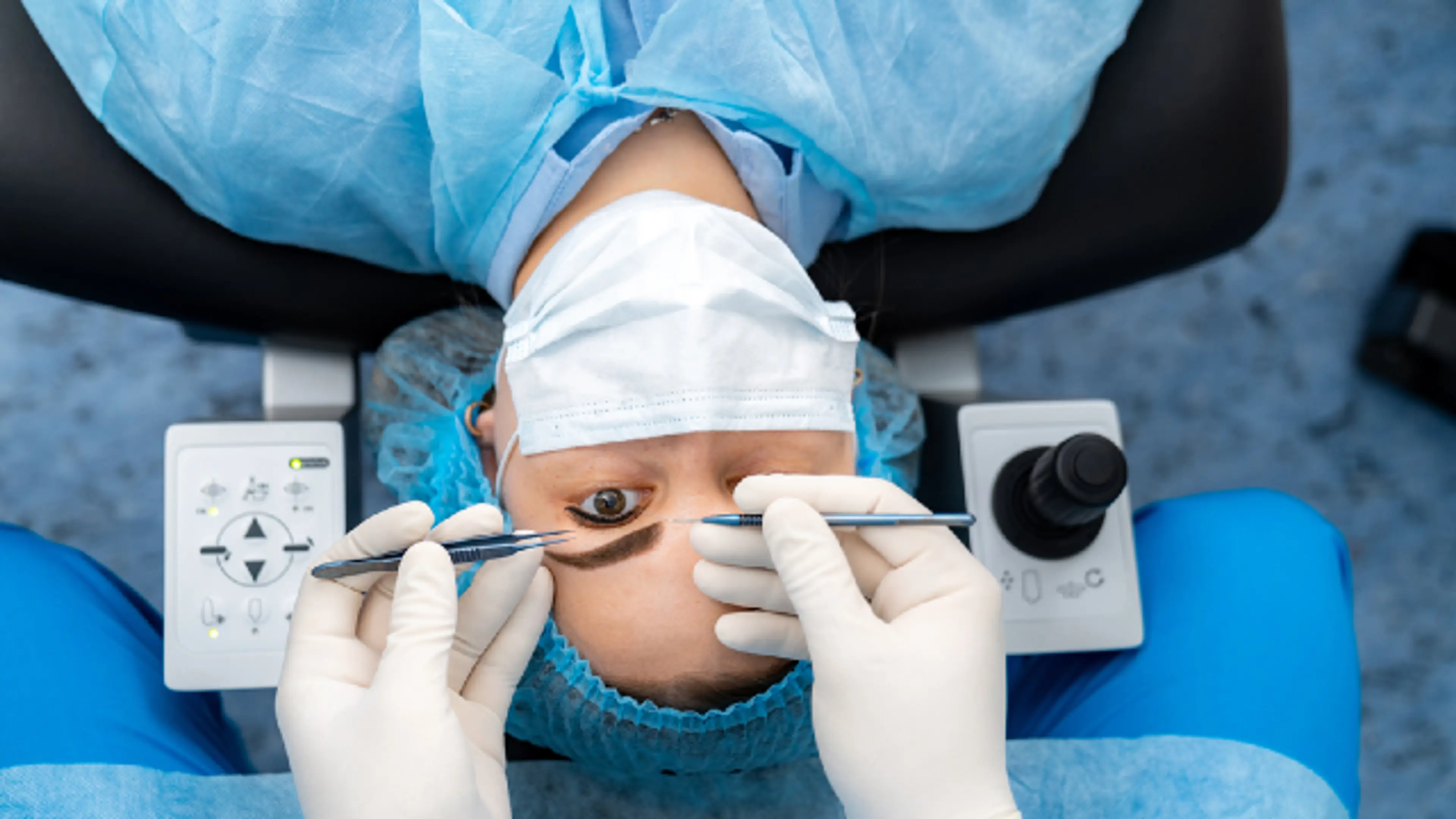
Surgery day at Gangnam Joeunnun Vision Clinic begins with final pre-operative measurements, confirmation of your prescription, and the application of numbing drops — you will feel no pain during the procedure itself. The full procedure, including preparation, positioning, and both eyes, takes approximately 15 to 20 minutes total. The laser extraction per eye takes approximately 30 seconds on the ZEISS VisuMax platform. After the procedure, protective eye shields are placed immediately, and you are escorted to the clinic's recovery area for 30 to 60 minutes for initial monitoring.
Day | Vision Status | Comfort Level | Permitted Activities |
|---|---|---|---|
Day 0 | Hazy to foggy | Mild pressure, tearing, light sensitivity | Hotel rest only; no screens; sleep |
Day 1 | Foggy to functional | Light sensitivity present; foreign-body sensation reducing | Post-op appointment; gentle walk; short phone/tablet use |
Day 2 | Clear but not crisp | Mild halos at night; outdoor sensitivity with sunglasses | Café dining; light sightseeing; short screen sessions |
Day 3 | Clear; near-normal | Most patients feel nearly normal | Full workday screen use with breaks; Myeongdong shopping |
Day 4 | 20/20 approaching | Minor fluctuations normal | Follow-up appointment; Gangnam outdoor activity |
Day 5 | Stable and clear | Minimal symptoms | Flight clearance possible; city sightseeing |
Day 6–7 | Stable | Essentially normal | Light Seoul tourism; observation decks; cultural visits |
The Day 1 post-operative appointment at Gangnam Joeunnun Vision Clinic is mandatory for all patients — it is not optional and should not be rescheduled. At this appointment, Dr. Kim Jun Heon's team will test your visual acuity, examine the incision site under slit-lamp magnification, check your intraocular pressure, and confirm your eye drop schedule. Most patients test between 20/25 and 20/40 at this appointment — this is entirely normal and will continue improving. It is common to feel anxious at Day 1 if your vision is not yet sharp; understand that this appointment exists precisely to confirm that your healing is proceeding exactly as expected, not to tell you that you have reached your final outcome.
After the appointment, most patients are comfortable taking a gentle walk in Gangnam. Wear your dark UV-protective sunglasses outdoors — bright direct sunlight is your primary environmental concern at this stage. Light screen use — phone or tablet for short periods — is acceptable from Day 1, but apply the 20-20-20 rule consistently: every 20 minutes, look at something 20 feet away for 20 seconds. This reduces ciliary muscle fatigue and supports comfortable visual recovery. By the evening of Day 1, most patients describe their vision as noticeably clearer than it was the previous evening — the progress curve is steep and encouraging in these early hours.
By Day 2, the majority of patients describe their vision as "clear but not crisp" — a useful way to visualize it is looking through very slightly smudged glass that continues clearing further each hour. Light sensitivity is significantly reduced; most patients are comfortable outdoors with sunglasses. Mild halos around lights at night are normal at this stage and typically resolve within two to four weeks — they are a temporary artifact of the cornea's adaptation to its new refractive shape and do not indicate a problem.
Day 3 is the day most patients describe as their confidence inflection point. Vision is clear enough that the experience of having had surgery two days prior feels distant rather than immediate. Screen use including a full workday is acceptable from Day 3 with regular breaks. For patients with engineering, design, or other screen-intensive professional roles — Paul persona specifically — a full virtual workday is manageable from Day 3 with consistent lubricating drops and the 20-20-20 rule applied hourly.
By Days 4 and 5, vision for most patients is at or approaching 20/20 — some patients experience minor fluctuations between morning and evening, which are normal as the prescription continues settling. Day 4 brings the second critical appointment at Gangnam Joeunnun Vision Clinic: Dr. Kim Jun Heon assesses your readiness for international travel, reviews the incision site, and — for patients who are healing well — provides clearance for your long-haul flight home.
Days 5 through 7 are genuinely pleasant for most patients — vision is clear and stable, symptoms are minimal, and the city is yours to explore with appropriate precautions. Safe Seoul activities during this phase include visiting the Lotte World Tower observation deck, exploring Gyeongbokgung Palace with comfortable walking shoes and sunglasses, enjoying Gangnam's café culture, and walking the lanes of Bukchon Hanok Village (check wind conditions first — if it's breezy, save this for another day or wear close-fitting sunglasses). What to continue avoiding even on Day 7: swimming pools, hot tubs, contact sports, deliberate eye rubbing, and dusty or heavily polluted outdoor environments.
Activity clearances in Weeks 3 to 4 represent the return of a full active life. Weight training at moderate intensity is cleared. Yoga including inversions is cleared from Week 3. Group fitness classes are cleared. For Paul persona: golf is cleared at Week 4 for most patients, though confirmation at the Month 1 virtual follow-up with Dr. Kim Jun Heon is recommended before returning to competitive play. For Rachel persona: swimming in chlorinated pools is cleared at Week 4, with goggle use recommended for an additional two weeks of protective caution; ocean swimming is cleared at Week 6. For Lisa persona: full eye makeup including eyeliner and mascara is cleared at Weeks 3 to 4, with the important caveat that mascara should be applied carefully to avoid product entering the eye and requires a gentle, non-rubbing removal approach. Replace all eye makeup products that were opened before surgery.
Professional evening events, client dinners, and social engagements are fully feasible from Week 2 — no visible signs of surgery will be apparent for most patients by Week 3. This is an important reassurance for Lisa persona, who may have client-facing commitments in the early weeks post-return.
One of the most practical questions American patients ask — and the one that most recovery guides answer most vaguely — is when specific activities are cleared. This section provides sport-specific, profession-specific, and lifestyle-specific timelines with day-level precision, so you can plan your Seoul stay and your return home around what you actually need to do.
Activity | When Cleared | Notes |
|---|---|---|
Screen use — phone/computer (limited) | Day 2–3 | 20-20-20 rule; lubricating drops throughout |
Screen use — full day | Day 4 | Continue drops; reduce monitor brightness 60–70% |
Driving (daytime) | Day 3–4 | Confirmed clear vision required; no night driving |
Driving (night) | Week 2 | Clear once halos sufficiently reduced |
Return to office work (screen-based) | Day 3–5 | Work from home recommended for first 2–3 days |
Field work / site visits / outdoor professional | Day 5+ | Dusty/wind-exposed environments require Week 2 clearance |
Light walking | Day 1 | UV sunglasses required; avoid dusty/windy settings |
Light cardio (cycling, walking pace) | Week 2 | No sweat entering eyes; protective eyewear outdoors |
Gym / weight training (moderate) | Week 2–3 | No heavy overhead lifting until Week 3 |
Yoga (gentle, no inversions) | Week 2 | Inversions cleared Week 3 |
Running | Week 2 | UV-protective and wrap-around eyewear recommended |
Golf | Week 4 | Confirm at Month 1 virtual follow-up; UV sunglasses mandatory |
Foundation / eye-area-adjacent makeup | Week 2 | Keep product away from eye margin |
Eyeliner and mascara | Week 3–4 | Apply carefully; no rubbing to remove; replace pre-surgery products |
Swimming (chlorinated pool) | Week 4 | Goggles recommended for additional 2 weeks |
Ocean / open water swimming | Week 6 | Microorganisms and salt water require extended wait |
Contact sports (boxing, rugby, MMA) | Week 6 | Protective eyewear required indefinitely post-clearance |
Air travel (domestic US flights) | Day 3 minimum | Lubricating drops every hour during flight |
Air travel (international long-haul) | Day 5 recommended | Drops every hour; no alcohol; sleep mask for rest periods |
Direct water entry into the eye should be avoided for the first full week — tap water, pool water, sea water, and even shower water carry microorganisms that are harmless to healthy intact corneas but represent an infection risk during the early healing window. Showering with eyes closed is perfectly fine from Day 1; it is direct splash or submersion that should be avoided. Dusty and windy environments — construction sites, desert landscapes, heavily polluted urban air — should be avoided for the first two weeks, as airborne particles can lodge at the incision site and cause irritation or infection. Eye makeup within the incision zone should be deferred as detailed in the timeline above.
Contact lenses should never again be worn in the operated eyes — SMILE LASIK is specifically designed to eliminate this need permanently, and lens wear post-procedure would be both unnecessary and potentially harmful. Alcohol in moderation is fine from Day 3, but excessive alcohol consumption worsens dry eye sensation significantly during the early recovery period, particularly in combination with air travel or air-conditioned environments. UV-protective sunglasses are mandatory outdoors for the first full month — the healing cornea is more sensitive to UV radiation than a fully stabilized cornea, and consistent sun protection directly supports a smooth recovery.
Seoul is an extraordinary city to recover in, and with appropriate precautions, Days 2 through 7 are genuinely enjoyable. On Days 2 through 4, indoor Seoul is your world: Starfield COEX Mall in Gangnam is a world-class indoor destination with excellent dining, retail, and the famous underground library that requires no sunlight exposure. Lotte Department Store and its surrounding Gangnam area are fully accessible. Korean spa culture — jimjilbang — is partially accessible from Day 2 for indoor lounging and relaxation, with the caveat that hot tub and wet room submersion should be avoided entirely during the first week.
From Day 5 through 7, outdoor Seoul opens up. The Lotte World Tower observation deck on a clear day delivers some of Asia's most spectacular city views with minimal exertion. Gyeongbokgung Palace is well-suited to gentle, flat walking with sunglasses. Insadong's cultural street offers accessible pedestrian browsing. For Lisa persona: Gangnam luxury retail — the Cheongdamdong fashion district, Galleria Department Store — is fully accessible indoors from Day 2 and outdoors from Day 4 with sunglasses. For Rachel persona: the K-beauty shopping district of Myeongdong is accessible from Day 3 outdoors with sunglasses; avoid eye product sampling at store counters during the recovery period.
The Day 4 appointment at Gangnam Joeunnun Vision Clinic is where Dr. Kim Jun Heon reviews the incision site, confirms vision stability, assesses dry eye status, and provides explicit clearance for long-haul travel. A patient who flies on Day 3 — before this appointment — is flying without that confirmation, which means any issue that would have been caught and addressed at Day 4 is instead being managed mid-flight with no surgical support. For a twelve-to-fifteen-hour flight over the Pacific, that is a risk with no upside. The five-day minimum recommendation is specifically designed to include the Day 4 clearance appointment before you board.
City | Flight Duration (Seoul Incheon) | Minimum Stay Recommended |
|---|---|---|
New York (JFK/EWR) | ~14 hours | 5 days post-surgery |
Los Angeles (LAX) | ~12 hours | 5 days post-surgery |
Chicago (ORD) | ~14 hours | 5 days post-surgery |
Houston (IAH) | ~15 hours | 5 days post-surgery |
Phoenix (PHX) | ~13 hours | 5 days post-surgery |
A sleep mask is strongly recommended for the flight's sleep period — it reduces light exposure, prevents accidental eye rubbing during sleep, and keeps the eye area protected in the low-humidity cabin environment. A window seat gives you control over light exposure from the window and provides a stable surface to lean against for more protected rest. For Lisa persona specifically: business class on the Seoul-to-LA route (approximately 12 hours) is strongly recommended — lie-flat seats reduce physical stress, minimize eye irritation from sitting upright in dry air, and allow recovery-appropriate sleep in a safer, more comfortable position. This is a case where the upgrade cost has a genuine clinical rationale.
Avoid alcohol entirely on the first long-haul flight after surgery. Alcohol is a known contributor to dry eye by reducing tear production and quality; in a 15% humidity cabin at 35,000 feet, the combination is a significant aggravating factor that is entirely avoidable. If your eyes become significantly irritated mid-flight: apply lubricating drops, close your eyes, and place a cool damp cloth gently over your closed eyelids. Do not rub under any circumstances, even if the urge is strong.
Day one back home should be treated as an extension of your Seoul recovery, not an immediate return to full pace. Rest is valuable. Continue your prescribed eye drop schedule exactly as instructed. Avoid physical exertion for the first day after the long-haul flight — your body is managing jet lag, dehydration, and the cumulative effects of a 12-to-15-hour cabin environment, and your eyes benefit directly from the reduced systemic stress of genuine rest.
Work from home is strongly recommended for the first two to three days after landing. This is not because you are unwell — for most patients, vision is clear and comfortable — but because the commute, outdoor environmental exposure, and office air conditioning represent unnecessary variables during this transitional period. For Rachel persona: your UX design workstation should have monitor brightness reduced to 60 to 70% for the first two weeks; an anti-reflective screen filter is a worthwhile investment for this period and beyond. For Paul persona: virtual meetings and document review are fully feasible from Day 1 back home; site visits and outdoor fieldwork should wait until Week 2 when the healing incision site is more fully consolidated. For Lisa persona: client-facing professional events and evening engagements are feasible from Day 2 back home if recovery has proceeded normally — no visible signs of surgery will be apparent for most patients at this stage, and the clear-eyed confidence of excellent vision is the only visible change most observers will notice.
If you have a question or concern between scheduled appointments, the international patient WhatsApp line at Gangnam Joeunnun Vision Clinic maintains a response time of under four hours during Korean business hours. Photograph any visible concern with your phone camera and share it directly through the WhatsApp channel — the clinical team can assess most surface-level presentations from a clear photograph and advise on whether in-person examination is warranted.
If a concern requires in-person assessment, Gangnam Joeunnun Vision Clinic will issue a detailed clinical letter for your local US ophthalmologist, including the full surgical report, all refractive data, and a specific examination protocol recommendation. The letter is prepared in English and formatted for immediate use by any licensed US practitioner without additional translation or explanation.
Gangnam Joeunnun Vision Clinic provides all departing patients with a two-to-four-week supply of all post-operative medications, including the prescription antibiotic drops and anti-inflammatory drops that form the core of the early recovery protocol. For lubricating drops — the most heavily used element of your post-op routine — the take-home supply can be replenished at any US pharmacy without a prescription.
Recommended US pharmacy equivalents for preservative-free lubricating drops include Refresh Optive Advanced, Systane Ultra, and TheraTears — all are available over the counter at CVS, Walgreens, Walmart, and most major pharmacies. For Paul persona: CVS or Walgreens same-day availability means there is no need to ration your clinic-provided drops on the flight home; replenishment is a five-minute errand on any US Main Street. If additional prescription anti-inflammatory or antibiotic drops are needed beyond the provided supply, the clinic will issue a written prescription formatted for compatibility with US pharmacy dispensing systems; your local pharmacist can fill the US equivalent with no additional documentation.
For American patients considering SMILE LASIK in Seoul, the question is not whether Seoul is a credible destination for world-class refractive surgery — the clinical evidence and international patient outcomes make that case clearly. The question is which Seoul clinic delivers the combination of surgical precision, research credibility, international patient infrastructure, and post-operative continuity of care that justifies crossing the Pacific. For information on the total cost of SMILE LASIK in Seoul compared to US pricing, that dedicated guide provides city-by-city cost comparisons with full cost-of-care context. For a comprehensive overview of what makes Gangnam Joeunnun Vision Clinic different, including the full ZEISS partnership and SCI research record, that companion article covers the clinic's credentials in depth.
His direct collaboration with ZEISS — the developer of SMILE technology — is not a standard vendor relationship. It is a clinical development partnership that provides access to the highest-precision calibration specifications available for the VisuMax platform, ongoing participation in research and technology refinement, and a level of procedural familiarity with ZEISS systems that generalist clinics cannot replicate from equipment purchase alone. Dr. Kim's SCI-indexed research publications — peer-reviewed contributions to internationally indexed ophthalmology literature — provide an evidence base for outcomes at Gangnam Joeunnun Vision Clinic that the vast majority of vision correction clinics, domestic or international, cannot match with published data. He is a member of the Korean Ophthalmological Society and relevant international refractive surgery professional bodies, ensuring his practice standards are continuously aligned with the global state of the specialty.
The ZEISS collaboration that defines Gangnam Joeunnun Vision Clinic's technical platform is directly relevant to your recovery experience, not just to the surgery itself. The ZEISS VisuMax platform, calibrated to the highest precision specifications available, delivers the lenticule extraction through a 2 to 4mm incision — significantly smaller than the large corneal flap of traditional LASIK. This smaller incision is the direct mechanical cause of SMILE's superior recovery profile: less surface disruption, fewer corneal nerves affected, smaller healing area, and lower risk of flap-related complications that can extend LASIK recovery by weeks.
Patients choosing Gangnam Joeunnun Vision Clinic receive the same ZEISS VisuMax technology used in leading academic medical centers in Germany, Japan, and the United States — at a fraction of the US cost, performed by a surgeon with published research on the outcomes this specific platform delivers. The VisuMax's 30-second laser extraction time per eye minimizes cumulative corneal stress during the procedure and is a contributing factor to the speed of early recovery that Dr. Kim's patients consistently report.
Gangnam Joeunnun Vision Clinic's international patient infrastructure is built for American patients specifically — not adapted from a Korean-language system as an afterthought. English-speaking patient coordinators handle all communications from first inquiry through the Month 3 follow-up appointment. Virtual consultations are available via Zoom or Google Meet before travel. Pre-arrival materials include full pre-operative instructions, accommodation recommendations near the clinic, airport transfer guidance, and a day-by-day Seoul itinerary from consultation through final post-op clearance.
Post-surgery support includes a comprehensive written post-op report, the international patient follow-up schedule with pre-set appointment times, and the WhatsApp support line with sub-four-hour response times during Korean business hours. Virtual follow-up appointments at Week 2, Month 1, and Month 3 are scheduled before departure, ensuring that continuity of care across the Pacific is structured, not improvised.
For American patients who have done the research and are ready to move from planning to action, the booking process at Gangnam Joeunnun Vision Clinic is designed to be simple, remote, and fully English-language from first contact through pre-arrival.
Virtual consultations with Gangnam Joeunnun Vision Clinic are available via Zoom or Google Meet at no cost and no obligation. The consultation covers your current prescription, eye health history, lifestyle goals, and procedure recommendation — including whether SMILE LASIK or ICL implantation is the appropriate recommendation for your individual corneal profile. The consultation is conducted in English with Dr. Kim Jun Heon or a senior clinical team member. To prepare, bring your most recent eye prescription and any previous eye examination records. Booking is available via the clinic website, WhatsApp, or email.
Following your virtual consultation, the clinical team issues a personalized treatment plan confirming your procedure type, pre-operative preparation instructions, and — if you wear contact lenses — your contact lens cessation timeline, which must be observed before surgery to allow the cornea to return to its natural shape. International patients receive a complete pre-arrival guide covering accommodation recommendations near the clinic in Gangnam, what to bring on surgery day, and the day-by-day Seoul itinerary from consultation through final post-op clearance. Payment and booking confirmation are completed remotely prior to travel.
# | Question Topic | Keywords Included |
|---|---|---|
1 | Minimum Seoul stay duration | SMILE LASIK recovery, flying after SMILE LASIK |
2 | Flying to US cities 3 days post-surgery | SMILE LASIK recovery time, flying after SMILE LASIK |
3 | Pain level during recovery | SMILE LASIK recovery, SMILE LASIK side effects |
4 | Return to work timeline | Return to work after SMILE LASIK, SMILE LASIK recovery |
5 | Exercise and gym timeline | Exercise after SMILE LASIK, SMILE LASIK recovery time |
6 | Eye makeup clearance | SMILE LASIK recovery week by week |
7 | Swimming clearance | SMILE LASIK recovery, SMILE LASIK recovery time |
8 | Dry eyes during recovery | Dry eyes after SMILE LASIK, SMILE LASIK vs LASIK recovery |
9 | Halos and glare during recovery | SMILE LASIK side effects, SMILE LASIK recovery |
10 | Eye drops — types and US sourcing | Eye drops after SMILE LASIK, post-op care SMILE LASIK |
11 | Vision stabilization timeline | Vision stabilization after SMILE LASIK, SMILE LASIK recovery week by week |
12 | Post-return follow-up care | Gangnam Joeunnun Vision Clinic, post-op care SMILE LASIK |
13 | What to do if something goes wrong in the USA | SMILE LASIK recovery, Gangnam Joeunnun Vision Clinic |
Dr. Kim Jun Heon is the Representative Director of Gangnam Joeunnun Vision Clinic in Seoul, South Korea, and a specialist in corneal and refractive surgery. His clinical focus encompasses SMILE LASIK, ICL implantation, cataract surgery, and advanced vision correction procedures, with a current surgical volume of approximately 200+ procedures per year. Dr. Kim is a ZEISS Clinical Collaboration Partner — the developer of SMILE technology — and the author of SCI-indexed peer-reviewed research in refractive and corneal surgery. He is a member of the Korean Ophthalmological Society and relevant international refractive surgery professional bodies.
For consultations: